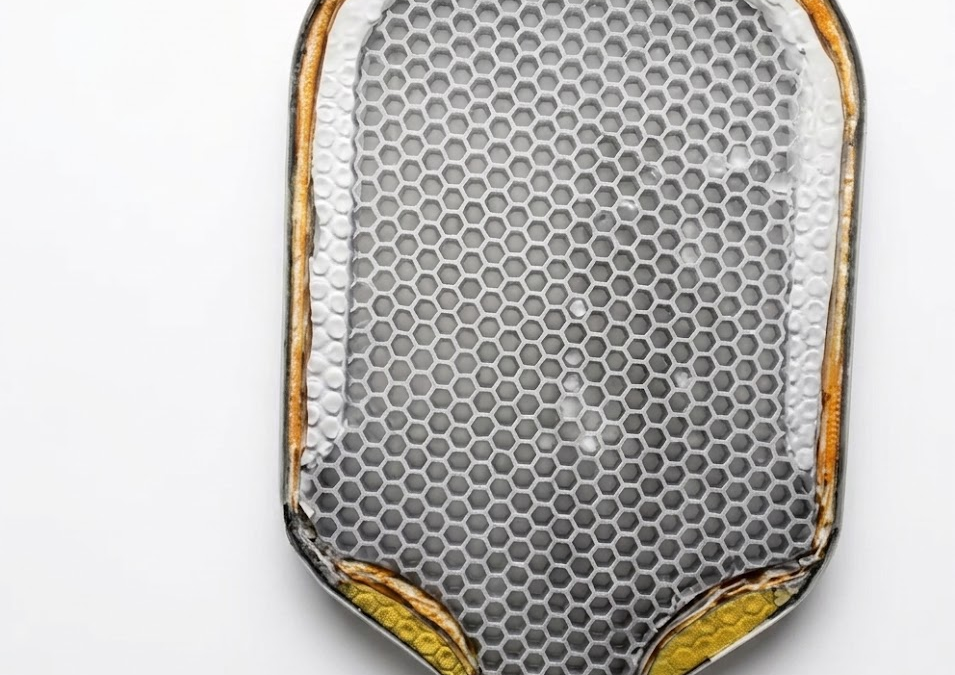
A Gen 4 paddle is a polypropylene honeycomb paddle with foam added in two places: the perimeter wall and the throat. The main core is still honeycomb, not solid foam. “Gen 4” is a brand-marketing label, not an official standard — no governing body defines these generation numbers.
This article covers what Gen 4 adds, how it differs from Gen 3 and Gen 5, what the “foam core” label really means, and what to confirm with a factory.
The Short Answer: Foam at the Perimeter, the Throat, and Sometimes the Core
Count where foam sits in a paddle and you can sort the market quickly:
- Foam in the perimeter only — the edge ring is softened. Most brands call this Gen 3.
- Foam in the perimeter and the throat — the neck area is damped as well. This is what brands call Gen 4.
- Foam as the whole core — honeycomb is replaced by molded EPP. Brands call this Gen 5.
So a Gen 4 build has two foam applications, not one. The throat addition is the main difference between Gen 3 and Gen 4 in most product lines.
Where the Generation Names Came From: Gen 1 to Gen 5 at a Glance
The generation names came from paddle brands, not a standards body. USAP certifies paddles for tournament play but does not recognize “generations.” The labels work as shorthand, and they vary between companies. The common pattern:
| Label | Core | Foam | What Changed |
|---|---|---|---|
| Gen 1 | Polymer honeycomb | None | Baseline composite build |
| Gen 2 | Honeycomb, sealed edge | None | Edge protection improved |
| Gen 3 | Honeycomb | Perimeter wall (EVA, 5–6 mm) | Softer edges, less edge damage |
| Gen 4 | Honeycomb | Perimeter + throat | Less shock near the hand |
| Gen 5 | Molded EPP foam | Perimeter wall | Core material replaced |
Treat this as a map, not a rulebook. When a brand quotes a generation number, ask where the foam sits.
What Gen 4 Adds: The Throat Foam Layer Explained
The throat is the narrow section between the paddle body and the handle. It is a high-stress zone: every hit sends force through it, and off-center hits add torque.
Honeycomb does poorly there. Cells near the throat crush faster than cells in the middle of the face, which is why older paddles go dead near the handle after months of play.
Gen 4 inserts a foam piece into the throat during assembly. The foam is usually EVA, cut to match the cavity, then bonded under heat and pressure.
Two things matter in production: the foam must fill the cavity completely, and the bond line must hold. A gap creates a soft spot; a weak bond creates a rattle.
How Throat Foam Changes Balance, Sweet Spot and Vibration
Three measurable effects, in order of how much players notice.
Vibration. This is the biggest change. Damping material near the handle absorbs shock closest to your hand, so less reaches the wrist. A Gen 4 paddle does not match a full EPP core on vibration, but it clearly beats a Gen 3 build with perimeter foam alone.
Sweet spot. Honeycomb paddles tend to go dead near the throat. Filling that zone with foam keeps the response more even, so the usable hitting area extends lower on the face. Players who hit low and late — a common habit in doubles — feel this immediately.
Balance. Foam in the throat adds a little mass in the middle of the paddle. Factory builds still hold finished weight at 225 g ± 5 g by accounting for it, so the change shows as balance rather than weight. The paddle swings more evenly instead of tip-heavy.
Gen 4 vs Gen 3 vs Gen 5: What Actually Differs
| Gen 3 | Gen 4 | Gen 5 | |
|---|---|---|---|
| Core | Honeycomb | Honeycomb | Molded EPP |
| Foam locations | Perimeter | Perimeter + throat | Perimeter (core is foam) |
| Vibration damping | Moderate | Better | Best |
| Feel | Crisp, lively | Crisp with softer edges and neck | Plush and quiet |
| Typical weight | 220–230 g | 225 g ± 5 g | 225 g ± 5 g |
| Factory cost | Lower | Mid | Highest |
| Best for | Power-first players | Players who want honeycomb pop with less shock | Comfort-first buyers |
The honest summary: Gen 4 keeps honeycomb’s crisp response and removes some harshness. Gen 5 removes more of it but changes the feel. They are different products, not better and worse versions of one product.
“Foam Core” Naming: What Buyers Get Wrong
The phrase “foam core” covers all three foam layouts, which causes real confusion.
Buyers read “foam core” and picture a solid foam slab inside the paddle. In a Gen 4 build, that is not what they get. The core is honeycomb; foam sits at the edges and the throat.
If your product page says “foam core,” experienced customers will ask which layers are foam. If the answer is “perimeter and throat,” say exactly that. The claim has to match the build.
Two questions settle it every time:
- What material is the main core?
- Where exactly is the foam?
If the seller cannot answer both, ask for a cutaway photo.
What a Gen 4 Paddle Is Made Of: Specs and Build Options
A standard Gen 4 build looks like this:
- Core: polypropylene honeycomb, 14 mm or 16 mm total thickness
- Perimeter wall: EVA foam, 5–6 mm wide, bonded around the edge
- Throat insert: EVA foam, cut to the throat cavity and bonded during layup
- Face: carbon fiber for control, fiberglass for a softer hit at lower cost
- Finished weight: 225 g ± 5 g, measured per paddle
- Handle: 5–6 inch grip, wrapped to the brand’s spec
Three choices change cost and feel: face material, core thickness, and whether foam inserts are die-cut (consistent) or hand-cut (cheaper, less consistent). Die-cut inserts cost more per unit but cut the risk of voids — the main cause of dead spots in foam-enhanced builds.
Who Should Manufacture a Gen 4 Line
Gen 4 assembly adds two processes to a basic honeycomb build: foam cutting and multi-layer bonding. That combination narrows the supplier list.
What a factory needs to run this well:
- Honeycomb cutting and expansion equipment, so core thickness holds across a run
- Foam cutting to tight tolerance — voids only appear when inserts are undersized
- A heat press with controlled temperature and pressure, because the bond is what fails first
- Inspection that includes cutaway samples, not just finished-paddle photos
The skills overlap with foam core production. A factory that already molds and cuts foam at scale — the same in-house capability a dedicated EPP foam core paddle manufacturer runs every day — has the foam tooling, density control, and bonding experience a Gen 4 line needs. Suppliers that only cut honeycomb usually subcontract the foam work, which adds a handoff where quality can slip.
Practical numbers for planning: OEM pricing for foam-enhanced builds generally lands in the USD 25.00–40.00 per piece FOB band, samples take 7–15 days, the usual minimum order is 200 pieces, and runs of 2,000 pieces or fewer take about 35 days.
How to Verify a Gen 4 Build Before You Buy
Check these before you approve a production run:
- Cutaway sample. Look at the throat cavity. It should be fully filled, with no visible gaps at the bond line.
- Foam thickness measurement. Confirm the perimeter wall is 5–6 mm, measured, not quoted.
- Per-paddle weight. Weigh several units. A 225 g ± 5 g spec should hold on each paddle, not on average.
- Tap test. Rap the face across the whole surface, including near the throat. A dull change in sound marks a void.
- Two-week playtest. Play real games, including low and off-center hits. Feel for rattles after heavy use.
- Edge stress test. Push on the perimeter wall. EVA should flex and recover, not crack or separate.
FAQ: Is Gen 4 a True Foam Core? Is It Better Than Gen 3? Why Not Go Straight to Gen 5?
Is Gen 4 a true foam core paddle?
No. The main core is polypropylene honeycomb. Foam appears at the perimeter and the throat. A true foam core paddle — where molded foam replaces the honeycomb entirely — is what the market calls Gen 5.
Is Gen 4 better than Gen 3?
It damps more vibration and holds a more even response near the throat. The trade-off is slightly higher factory cost and a marginally softer feel. If players complain about sting on low hits, Gen 4 is the sensible upgrade.
Why not go straight to Gen 5?
Because Gen 5 changes the core material and the price. EPP cores cost more to mold, feel plusher, and mute the sharp pop some players want. Gen 4 keeps honeycomb feel and costs less. Many brands run both lines.
Final Checklist: Gen 4 Specs to Confirm With Your OEM
- Foam locations confirmed: perimeter and throat, not perimeter only
- Main core stated as honeycomb, so “foam core” claims stay accurate
- Perimeter wall 5–6 mm EVA, measured on a cutaway
- Throat cavity fully filled, bond line clean
- Core thickness 14 mm or 16 mm, held across the run
- Finished weight 225 g ± 5 g, checked per paddle
- Die-cut foam inserts specified, to limit voids
- FOB price, MOQ 200, sample lead time and production lead time in writing
Confirm those eight and your Gen 4 build is documented — and the “foam core” wording on the box will survive a customer’s questions.