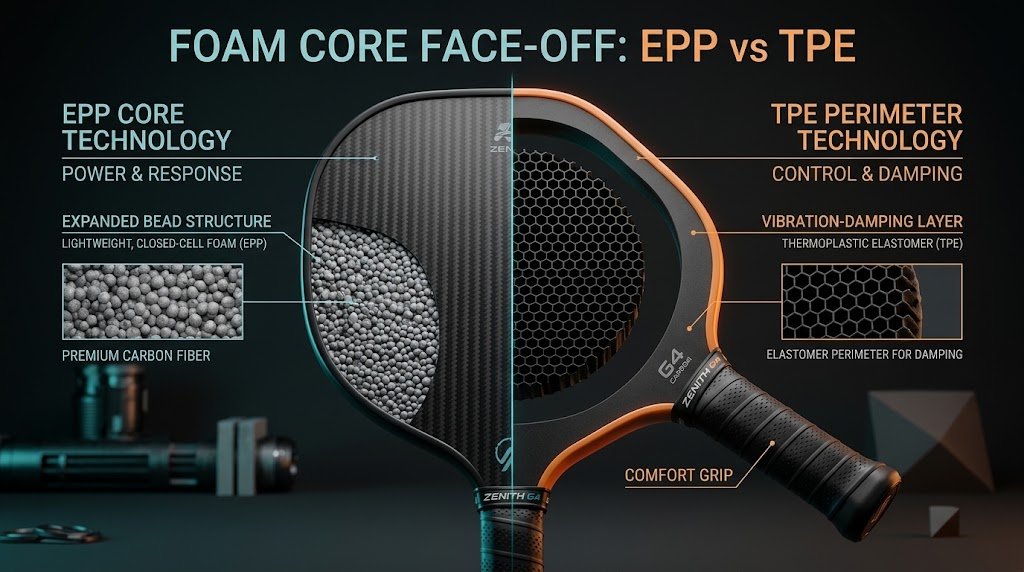
EPP and TPE rarely compete for the same job. EPP is almost always the answer when the foam is the whole core. TPE is almost always a ring or layer around a honeycomb core. Only a few brands sell a TPE full core — that niche is the only head-to-head matchup.
So ask what job the foam does first, then compare materials inside that job.
The Short Answer: They Are Not Direct Competitors — and That Is the Point
Three structures cover nearly every foam paddle on the market:
- EPP as a full core. Carries the whole face. Mature, durable, comfort-positioned.
- TPE as a full core. The rare route, sold on a recyclable-material story.
- TPE as a perimeter ring or layer. The common use: a damping gasket around a PP honeycomb or thin core.
Only the second competes with EPP directly. The other two serve different jobs and buyers, so judge each material in its own job.
What “TPE” Actually Means (and Why the Label Misleads Buyers)
TPE stands for thermoplastic elastomer — a family name, not one formula. Hardness, density, rebound, and heat resistance vary widely inside it. EVA and EPP are separate families again. None of the three ranks by name.
So “TPE core” on a quote says almost nothing. Ask for six things: grade and supplier, density in g/L, hardness with test method, thickness, layer position, and bonding method.
Where Each Foam Sits in a Paddle: Core, Perimeter or Layer
Five jobs exist in real builds: full core; perimeter support; edge or throat reinforcement; handle filler; interlayer in a mixed build. The same foam is judged differently in each job. A core carries the face and the weight plan; a ring supports the edge and shifts mass.
The generation labels the market uses: Gen 3 — PP honeycomb plus perimeter foam injection. Gen 4 — the same, plus throat foam. Gen 5 — molded EPP core plus an EVA ring.
Keep two builds apart: PP + EVA injection (Gen 3/4) and EPP core + EVA ring (Gen 5) are different structures. Both sell as “foam core,” which is why spec sheets get messy.
Case 1: EPP as a Full Core — What You Get
Strengths. Closed cells rebound instead of collapsing. The core stays light, holds shape for years, and recycles. Feel is damped — a low “thump,” not a crisp “pop.”
Costs. The face is less crisp than PP honeycomb, which matters to players who want instant feedback. And a bare EPP edge is soft, so it needs an EVA ring. FOB runs higher than a honeycomb build.
One parameter note: expansion ratio sets feel direction — lower firmer, higher softer — but ratio only means something next to a density figure. Ask for g/L, not adjectives.
Case 2: TPE as a Full Core — The Rare Premium Route
Industry sources put full TPE cores at only a few brands. The value is not performance; it is the story of a fully recyclable paddle, which Gen 1 to Gen 3 structures cannot claim.
The costs are concrete: the TPE supply chain is less mature than EPP’s, so raw-material lead time is the bottleneck, and certification usually adds roughness and PBCoR testing. This route suits a technology-led brand with schedule room, not a first product.
Case 3: TPE as a Perimeter Ring or Layer — The Common Route
This is how TPE is mostly used. A ring or layer wraps a PP honeycomb core, or a thin 8 mm core, as an internal damping gasket. It blocks shock and absorbs high-frequency vibration while keeping the rebound the core allows — and it is also our own standard combination, alongside PP + EVA layer.
The business case: to improve feel without redesigning the paddle, a TPE or EVA layer costs less than switching cores and keeps the honeycomb pop the base SKU sells on.
Head-to-Head: Density, Feel, Damping, Resilience and Weight
Compare materials only inside the same job. Densities are in g/L — 1 kg/m³ equals 1 g/L, and industry articles often use kg/m³.
| Dimension | EPP | TPE |
|---|---|---|
| Density | broad band | formula-dependent; get the grade |
| Feel | damped, low thump | formula-dependent |
| Damping | absorbs high-frequency vibration | strong elastomer damping |
| Resilience | recovers shape well | varies by formula |
| Weight control | 225 g ± 5 g, ± 2–3 g premium | same targets, different mass plan |
Industry figures cite honeycomb at an equivalent 60–80 g/L; foam cores tune wider. That is why a density number is the only fair basis for comparison. Hardness helps too — only with its test method.
Durability: Compression Set, Fatigue and What Fails First
Each material fails in its own way:
- Low-density EVA and some TPE formulas suffer compression set — after repeated impact they stay compressed.
- PP honeycomb fails by thin-wall fatigue collapse — that is what creates dead spots.
- EPP resists collapse best, because closed cells return to shape.
But service life comes from density, expansion ratio, and bonding quality — not the material name. A low-density, sloppily bonded batch of “EPP” fails before a well-built batch of another foam. We verify structure, not labels: X-ray inspection, compression testing on production samples, ball-cannon impact testing, and batch QC reports.
Sample-to-bulk inconsistency is the top return trigger in this industry. The fix is locking process parameters, not swapping materials.
Manufacturing: Expansion Ratio, Tooling, Lead Time and Supply Chain
Foam cores need foaming equipment and dedicated molds; a honeycomb line does not convert straight across. Industry figures put that retrofit in the five-to-six figure USD range — directional, confirm by quote.
EPP is the more mature foaming system, which shows in scheduling. TPE raw-material lead times run longer. Committable on our side: samples 10–15 days, 2,000 pieces or fewer in about 35 days, hot-press capacity around 80,000 pieces a month, 24-hour response, MOQ 200.
The question that matters is not “do you support foam?” but “how many foam-core paddles has this line run this year?” A capable EPP foam core paddle supplier answers with capacity and batch data, not a yes.
Certification: USAP Testing, PBCoR and Timelines
Core material is not restricted under current rules. Certification belongs to the brand; the factory supplies compliant samples and supports testing. EPP and EVA paths are mature. Newer TPE grades usually need roughness and PBCoR testing, so the window is longer.
Our in-house USAP and PBCoR pre-checks clear structural problems before a sample reaches a lab.
Scheduling rule: put certification time in the launch schedule, not inside the production window.
Cost and Positioning: Where Each Foam Makes Money
Core cost magnitude, industry-cited and directional: entry EVA cores lowest, standard-density EPP in the middle, custom-density or multilayer EPP + EVA + TPE highest. Confirm against a real quote.
FOB tiers we quote from:
| Tier | Build | FOB | MOQ |
|---|---|---|---|
| Entry | fiberglass + EVA core | USD 8.00–15.00 | 500+ |
| Mid | 3K carbon + mid-density EVA | USD 15.00–35.00 | 300+ |
| High | 12K/18K + multilayer core | USD 35.00–65.00 | 200+ |
| Flagship | ceramic-sand surface + custom core | USD 50.00–100.00 | 100+ |
Margin comes three ways: TPE core as narrative pricing, EPP core as durability pricing, PP + TPE layer as a cheap comfort upgrade sold as a version.
Which Foam for Which SKU: Four Brand Scenarios
- First product. Honeycomb, or PP + EVA/TPE layer. Do not launch on a TPE full core.
- Mid-range line extension. PP honeycomb base, +EVA or +TPE as a comfort version. One core, two price tiers.
- Premium flagship. EPP full core + EVA ring, sold on no-collapse structure, comfort, and consistency.
- Technology narrative. TPE full core, sold on recyclability — only if you accept longer lead times and heavier certification cost.
What to Ask Before You Approve a Foam Spec (and Red Flags)
Red flags that should stop a quote:
- A material name with no density number.
- No layer-position drawing or cutaway photo.
- TPE described as one fixed performance tier.
- No fatigue or compression-set data.
- “The sample feels great” offered as quality evidence.
FAQ
Is TPE better than EPP?
Not in general. TPE is a family of formulas and cannot hold one rank. In a full core, EPP is the proven route; as a ring, TPE works well and costs less.
Is EPP a foam or a honeycomb?
EPP is a foam. Honeycomb is a cell structure cut from sheets, usually polypropylene — EPP is molded from expanded beads into a solid core.
Can I use TPE as a full core, or only as an edge layer?
Both exist. The edge layer is mainstream; a full TPE core is the rare premium route, with longer timelines.
Do EPP and TPE paddles pass USAP certification?
Core material is not restricted. Certification depends on the finished paddle and belongs to the brand. EPP and EVA paths are routine; newer TPE grades add time.
Which lasts longer — EPP, TPE or EVA?
EPP resists collapse best. Low-density EVA and some TPE formulas risk compression set. Density and bonding matter more than the name.
Final Checklist: Foam Specs to Confirm Before Ordering
- Material family and grade named
- Density stated in g/L, per batch
- Layer position shown in a cutaway photo
- Hardness with its test method
- Edge-wall design and thickness
- Bonding method specified
- Compression-set and fatigue data on production samples
- Weight spec and tolerance tier: ± 5 g or ± 2–3 g
- Certification plan outside the production window
- MOQ, sample lead time, batch QC reports agreed
Work through that list and the EPP-versus-TPE question answers itself: each foam goes to the job it was built for.